Diesen Beitrag auf Deutsch lesen →
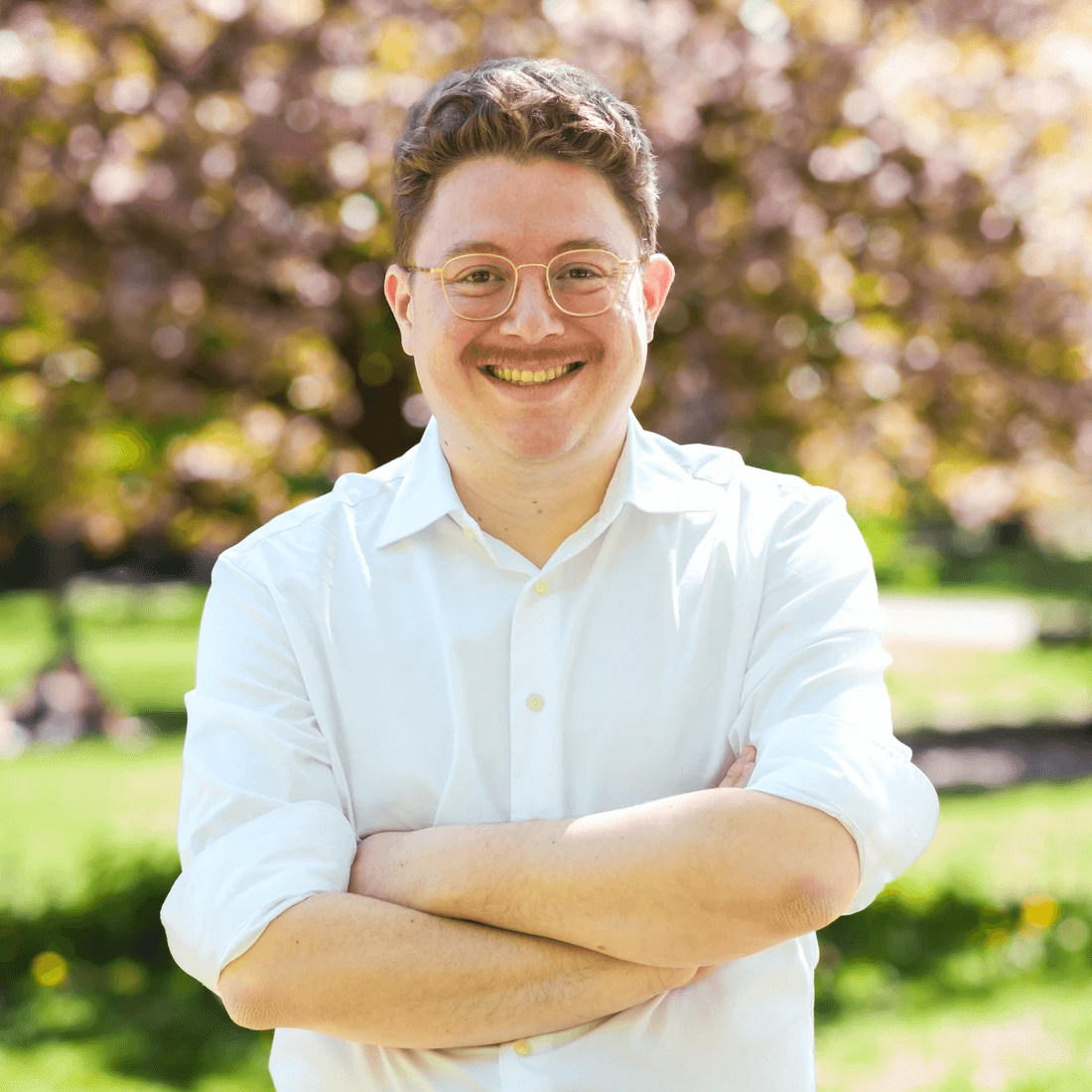
Daniel Eliasson
District councillor · Steglitz-Zehlendorf

My speech in the district council of Steglitz-Zehlendorf regarding the renaming of Treitschkestraße. January 22nd, 2025.
Ladies and Gentlemen,
If it were up to the governing coalition (Zählgemeinschaft), we would be speaking about Betty Katz today. About her work in the borough, about her life, about her dramatic fate, and her murder at the Theresienstadt concentration camp in June 1944. Yet life is not about wishful thinking, and the CDU on these benches still has not grasped that the decision to rename Treitschkestraße was taken two years ago, and that there is no majority here to overturn this right and long-overdue decision—not today, and in all likelihood, not in the future either.
Accept it, once and for all!
Be that as it may, I shall even do you the favour of asking the question myself:
Why should we rename Treitschkestraße at all?
After all, there are many compelling arguments against doing so.
The first argument: the ‘will’ of the local residents, which was canvassed once twelve years ago and revealed that the majority did not want the street renamed. This argument carries weight and gives one pause for thought. Upon reflection, however, it occurred to me that all the streets and squares named after Adolf Hitler were not renamed at the behest of the citizenry, but rather as part of denazification. And if you paid attention in history class, you will know that this was not a voluntary process. Yet it was a necessary one.
The second argument, far more important than the first, comes—according to the Berliner Morgenpost—from ‘sources within the CDU parliamentary group’. These ominous party sources remind us of the great pains we took to embed the name Treitschke within an ‘ensemble’. Without the antisemite Treitschke, they argue, commemorating the Jewish historian Harry Bresslau or erecting an information plaque about Treitschke’s antisemitism could scarcely be justified! The message is clear: the Jew alone does not suffice; he requires German antisemites to have any relevance. The name Betty Katz is certainly touching, yet is a Jewish woman murdered in the Holocaust truly suited to serving as a reminder of the horrific consequences of antisemitism? These are vital questions that each and every one of us here must presumably answer for ourselves.
The third argument comes from a prominent figure whom we have sorely missed on the Committee for Education and Culture for nearly two years now. The directly elected Member, Dr Wein, has resolved the ‘Treitschkestraße’ problem for us entirely by simply sweeping Treitschke’s hatred of Jews under the carpet in her newsletter to constituents. If people are led to believe that Heinrich von Treitschke was merely an influential historian and publicist who held controversial views, local residents are bound to wonder why left-wing, Green activists are once again out to tear down a distinguished German. After all, when the left-Green coalition renames streets, it frequently targets—and here I quote Dr Wein from the District Council (BVV) session in October 2022—‘people who also had good qualities, yet became entangled in difficult matters’. I once heard of an artistically inclined Autobahn builder who also took a rather wrong turn in life. I have already mentioned at the outset what happened to the streets and squares named after him.
However, what Dr Wein is peddling there is nothing particularly new for this local CDU, and I wish to make that entirely clear here. When we debated Treitschkestraße in this chamber in 2022, we heard the very same line from you, Mr Hippe. Treitschke was a child of his time, you claimed back then. Others were just as antisemitic, you said. What a staggering lack of historical knowledge! Treitschke’s antisemitism was so exceptional that it triggered the Berlin Antisemitism Controversy. He was no run-of-the-mill antisemite; he was a high performer, the Pelé of nineteenth-century antisemitism. He was ahead of his time; it took another fifty years for the hatred of Jews to become the raison d’état of National Socialist Germany.
In that vein, we move seamlessly on to the fourth argument. Every time the conversation turns to German crimes and German antisemitism, certain members in this chamber simply change the subject. Far more important than speaking about the Shoah, about right-wing extremists, or about the forefathers of German antisemitism, is criticising antisemitism from the left and within migrant communities, Mr Hippe. Some here maintain that Jewish people are threatened solely by antisemitism emanating from those groups. The antisemitism rendered socially acceptable through centuries of German culture and education—the very sort that manifested itself in writings such as Treitschke’s—is deemed inconsequential. We simply continue to honour the authors who laid the ideological foundations for Nazi antisemitism because left-wing antisemitism, because foreign antisemitism, is so grave. We focus on those who are to blame: and, as ever, that is solely ‘the others’!
And let us not forget the costs, the administrative burden! That is argument number five; I do hope everyone here is keeping count. Renaming Treitschkestraße might incur costs. And in this budgetary climate! Not to mention the administrative effort, about which the CDU and its District Councillor have demonstrably peddled untruths. Clearly, commemorating the victims of German hatred of Jews and taking a firm stand against antisemitism must never cost a penny, nor ever entail the slightest inconvenience. Perhaps we ought to poll the majority on how much funding should be allocated at all to protecting and fostering Jewish life in Germany and combating antisemitism. Better yet, let us omit the true extent of antisemitism from the briefing notes for the survey—that way, we can save ourselves the entire budget for tackling antisemitism in one fell swoop.
It would, of course, be far more cost-effective if we simply met every six months at Sderotplatz or at the Spiegelwand memorial—which you opposed as well—laid a wreath, patted ourselves on the back, and returned to our offices to draft letters to local residents in which we whitewash Treitschke’s antisemitism.
And if we do rename the street, where will it end? Are we soon to have no antisemites, racists, or war criminals left on our street signs at all? Ladies and Gentlemen, that would truly no longer be my Germany!
Mr Hippe, I do hope I have left a few of your arguments intact!
In all honesty, however, I am eager to see what new excuses you will concoct today to shirk taking consistent action against the antisemitism that the name ‘Treitschke’ keeps alive in our borough. Embarrassing yourselves, your entire parliamentary group, and your party evidently comes more easily to you than finally abandoning a dogmatically entrenched position.
Never was this more apparent than at this month’s Culture Committee meeting. One could see on the faces of your group members just how out of their depth they were in the face of a truly historic moment. There, you—and the CDU—were read the riot act: not only by Sigmount Königsberg, the Commissioner against Antisemitism of the Jewish Community of Berlin, no, Dr Felix Klein, the Federal Government Commissioner for Jewish Life in Germany and the Fight against Antisemitism, was also present and told you in no uncertain terms that tolerating a street named after Treitschke legitimises contemporary, everyday antisemitism. In other words, this is not a merely symbolic decision, Mr Hippe. This is an entirely practical decision against the hatred of Jews. Numerous residents of what is still Treitschkestraße stepped forward to give you a piece of their mind for your blinkered, backward-looking stance and your refusal to finally rectify your historical error. Your CDU colleagues on the committee even refused to applaud the two Commissioners. What is at stake here is your credibility as the CDU, Mr Hippe. Is there anything more important in politics than that?
The CDU has hardly cut a fine figure here for years, but this time, with the blunder by Dr Wein and her Steglitz CDU branch, you have scored a monumental own goal. And you really could have done without that second Culture Committee session, Mr Hippe. You personally landed the CDU in this utter embarrassment! Out there, nobody understands you anymore. Not even your own voters, quite a few of whom practise a genuinely uncompromising stance against all forms of antisemitism. In all likelihood, not even Governing Mayor Wegner understands what this is all about; after all, he would rename Hindenburgdamm himself. This ideological narrow-mindedness, this hard-right conservative ideology you are displaying here, is the exact antithesis of the pragmatic, mainstream civic politics you claim to represent.
To this day, neither the Steglitz CDU nor its directly elected representative, Dr Wein, has apologised for the letter of 17 December. Yet there are two thoroughly deserving recipients of such an apology. First and foremost, the Jewish people of this country. It is profoundly indecent and historically illiterate to issue a letter concerning Treitschkestraße that trivialises his repugnant views as merely ‘controversial’. ‘The Jews are our misfortune’ is not ‘controversial’! Secondly, you ought to apologise to the residents of what is still Treitschkestraße, whom you sought to mislead with that letter. You presented citizens with a grossly distorted picture of the facts, whilst rallying them to attend the committee meeting and join you in speaking out against the renaming. And then Dr Wein did not even attend the committee meeting—ostensibly due to illness, despite being back on her feet, fit as a fiddle, in the Berlin House of Representatives the very next day.
And do you know what is truly absurd, Mr Hippe? You act here as though removing the name Treitschke from a street sign were a revolutionary act. Yet even the Association of German Cities (Deutscher Städtetag)—hardly a hotbed of left-Green radicalism—has long since understood what is at stake, making it clear in its 2021 catalogue of criteria that street names do indeed constitute an honour, and that individuals unworthy of such honour have no business having streets named after them. The governing coalition is therefore following the recommendations of the Association of German Cities—properly and transparently. Treitschke will remain in the history books as a warning against the academic pioneers of hatred and crimes against humanity. And that is the only place he belongs.
Ladies and Gentlemen,
On paper, this motion may be about renaming a street, yet everyone present here today, and everyone who attended the Committee for Education and Culture, has heard it loud and clear: this is about far more than that. At its core, it is about how and why we engage in politics. Whether we are principled and honest, or whether we hide behind threadbare arguments and lie to the public out there.
In my view, the 2012 survey was a mistake.
We are faced with the fundamental question of whether we exercise the mandate entrusted to us by the citizens of this borough responsibly—even when that means taking difficult decisions that may meet with isolated criticism, yet are right and necessary for the greater good. Or whether, instead, we hide behind the putative ‘will of the people’ because we are either afraid of a backlash or unwilling to reconsider our own positions.
Speaking as a Green councillor today, I wish to make one thing clear: in my view, the 2012 survey was a mistake. Had I held political responsibility at the time, I would have fought resolutely against that compromise. Because one thing is beyond question: a CDU that addresses antisemitism solely at its own discretion and for political expediency is abdicating its responsibility!
Heinrich von Treitschke is part of Germany’s past, but his name has no place in our present or our future. There are ample places where the public is educated about his role as an antisemite and his contribution to the spread of anti-Jewish ideology—thanks in part to this very District Council—but a street sign in this borough, in this city, is the wrong place for it.
Let these arguments sink in. Rise above your partisan instincts today. Show the courage and foresight to abandon an untenable position rather than clinging to it. Show us that you are no longer the local party association to which an antisemite like Heinrich Lummer once belonged. Vote in favour of Betty-Katz-Straße.
Thank you very much.